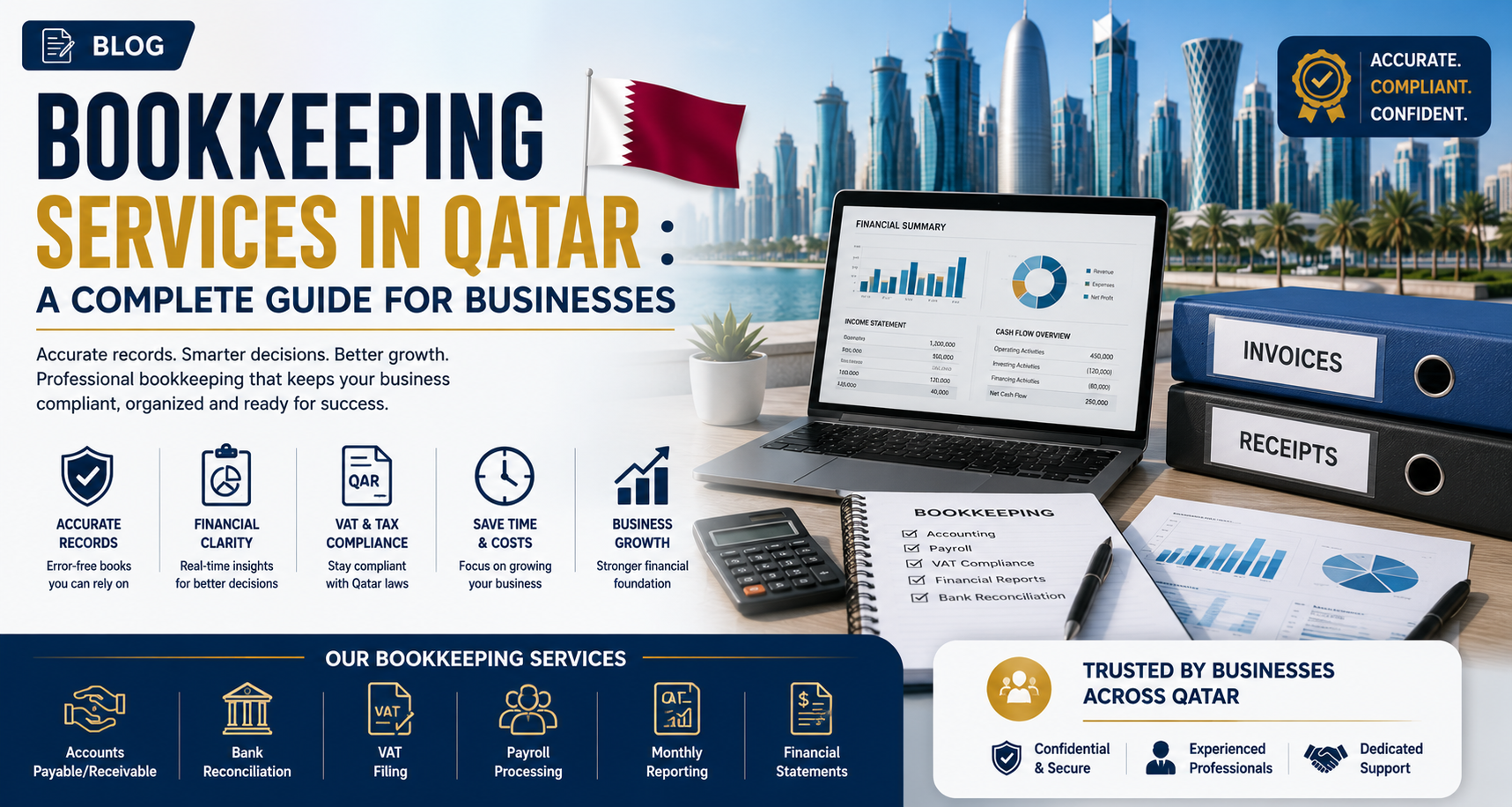
Bookkeeping services in Qatar help businesses record, organize, and review their financial transactions.
-
Good bookkeeping supports tax filing, audit readiness, cash flow control, and better business decisions.
-
A strong bookkeeping process includes bank reconciliation, invoice tracking, payroll records, expense control, and monthly reports.
-
Businesses in Qatar should keep accurate financial records because tax registration, tax returns, and supporting documents may be required depending on their legal structure and activity.
-
Outsourced bookkeeping can help business owners reduce errors, save time, and maintain clean records throughout the year.
Table of Contents
-
What are bookkeeping services in Qatar?
-
Why bookkeeping matters for Qatar businesses
-
What bookkeeping services usually include
-
How bookkeeping works step by step
-
Bookkeeping, tax compliance, and audit readiness
-
In-house vs outsourced bookkeeping
-
How to choose a bookkeeping service provider
-
Conclusion
-
FAQ
Bookkeeping Services in Qatar
Bookkeeping services in Qatar refer to the organized recording, classification, reconciliation, and reporting of a company’s financial transactions. These transactions include sales, purchases, receipts, payments, bank movements, employee-related costs, supplier bills, customer invoices, petty cash, and business expenses.
Bookkeeping is different from general business administration. It creates the financial base that accountants, tax consultants, auditors, and business owners use to prepare reports and make decisions. Without clean books, a company may not know whether it is profitable, how much cash it has, which invoices are overdue, or whether its records are ready for tax and audit review.
For businesses that need professional financial support, JBA & Partners has a dedicated Bookkeeping Services page and related financial service pages, including Accounting Advisory Services, IFRS Reporting, and Budgeting & Forecasting. JBA’s accounting service page states that its accounting team has experience across sectors and knowledge of IFRS and local rules and regulations.
Key Points and How It Works : Bookkeeping Services in Qatar
1. Bookkeeping starts with proper financial setup
A good bookkeeping system starts before the first transaction is entered. The business needs a chart of accounts, document filing structure, invoice format, approval process, payment process, and monthly reporting calendar.
The chart of accounts is the list of categories used to organize financial activity. For example, sales may be separated by product line or service type. Expenses may be separated into rent, salaries, professional fees, utilities, software, transport, marketing, and bank charges. This structure makes monthly reports easier to understand.
For a company operating in Qatar, bookkeeping setup should also consider the business’s commercial registration, activity type, ownership structure, tax position, and reporting requirements. The Ministry of Commerce and Industry’s Commercial Registration and Licenses Department is responsible for matters such as commercial registrations, commercial entities, commercial license applications, and the Commercial Registry.
2. Daily transactions must be recorded accurately
Bookkeeping is not only a month-end activity. It works best when transactions are recorded regularly. Daily or weekly updates reduce missing documents and make it easier to resolve questions while the information is still fresh.
Common transactions include:
-
Customer invoices
-
Supplier invoices
-
Cash receipts
-
Online payments
-
Bank transfers
-
Payroll costs
-
Petty cash expenses
-
Reimbursements
-
Loans and financing costs
-
Owner or shareholder transactions
A clear bookkeeping process answers simple but important questions. Who approved the expense? Was the invoice paid? Which bank account was used? Is the receipt attached? Is the transaction business-related? These small details can become important during tax filing, audit review, financing applications, or management reporting.
3. Bank reconciliation is a core monthly task
Bank reconciliation means comparing the company’s accounting records with bank statements. This helps identify missing entries, duplicate entries, bank charges, unrecorded payments, and timing differences.
For example, a customer may have paid an invoice, but the payment may not have been matched in the accounting software. A supplier payment may have been recorded twice. A bank charge may have been missed. Without reconciliation, the company may think it has more or less cash than it actually has.
A reliable bookkeeping service should reconcile all bank accounts, cash accounts, card accounts, and payment gateway accounts. The goal is simple: the books should match the real financial position of the business.
4. Receivables and payables need active control
Bookkeeping also helps manage money owed to and by the business.
Accounts receivable means money customers owe to the company. If customer invoices are not tracked, collections become weak. The company may sell well but still face cash shortages.
Accounts payable means money the company owes to suppliers. If payables are not tracked, the business may miss due dates, damage supplier relationships, or lose control of cash planning.
A monthly bookkeeping report should show:
-
Unpaid customer invoices
-
Overdue receivables
-
Supplier bills due soon
-
Old unpaid supplier balances
-
Disputed invoices
-
Advances received or paid
-
Customer deposits
-
Supplier deposits
This is where bookkeeping becomes more than data entry. It becomes a practical cash flow tool.
5. Payroll, WPS, and employee records should be organized
Employee-related financial records must be handled carefully. Bookkeeping should track salaries, allowances, deductions, reimbursements, leave settlements, end-of-service provisions where applicable, and payroll payments.
JBA’s accounting services page lists general business support such as payroll processing/WPS, fixed asset management, inventory record verification, interim bookkeepers/controllers, and financial report preparation among its service areas.
For business owners, payroll bookkeeping helps answer questions such as:
-
What is the monthly salary cost?
-
Were all staff paid correctly?
-
Are reimbursements supported by documents?
-
Are payroll expenses classified correctly?
-
Are employee advances tracked?
-
Are end-of-service and leave-related amounts visible?
Payroll errors affect both employees and business records. That is why payroll should be connected to the bookkeeping system instead of being managed separately in informal spreadsheets.
6. Monthly management reports help owners make decisions
Good bookkeeping should result in useful reports. A company should not wait until year-end to discover its financial condition. Monthly reports allow owners and managers to react early.
Useful reports include:
-
Profit and loss statement
-
Balance sheet
-
Cash flow summary
-
Bank reconciliation report
-
Accounts receivable ageing
-
Accounts payable ageing
-
Expense breakdown
-
Revenue by service or product
-
Budget vs actual comparison
A clean profit and loss statement helps answer whether the business is profitable. A balance sheet shows assets, liabilities, receivables, payables, and equity. A cash flow report shows how money is moving in and out. These reports are useful for pricing, hiring, expansion, cost control, and financing discussions.
7. Bookkeeping supports tax compliance in Qatar
Bookkeeping is closely connected to tax compliance. Qatar’s General Tax Authority states that, under Law No. 24 of 2018 and its amendment, the applicable tax rate for the tax year is 10% of taxable income, with specific exemptions and special rules for certain sectors and ownership situations.
The JBA Corporate Income Tax page states that income earned by a resident corporate body inside Qatar is subject to a 10% corporate income tax rate, and that tax returns should be submitted within four months from the end of the accounting period.
This is why bookkeeping should not be treated as a last-minute year-end exercise. If the books are incomplete, the tax return process becomes slower and riskier. Missing invoices, unclear expense classifications, unreconciled bank accounts, and unsupported transactions can create avoidable problems.
8. Bookkeeping makes audits easier
Even when a business is not preparing for an immediate audit, audit readiness is a good habit. Auditors often ask for invoices, contracts, bank statements, reconciliations, fixed asset registers, payroll records, supplier statements, and explanations for unusual transactions.
If these records are prepared throughout the year, audit work becomes more efficient. If they are missing, the business may face delays, extra cost, and repeated questions.
9. In-house bookkeeping vs outsourced bookkeeping
Some businesses hire an in-house bookkeeper. Others outsource the function. The right choice depends on transaction volume, budget, internal control needs, management expectations, and the complexity of the business.
In-house bookkeeping may work well when:
-
The company has daily transaction volume.
-
Documents are created and approved internally.
-
The owner wants a full-time finance person.
-
There are many customer and supplier interactions.
Outsourced bookkeeping may work well when:
-
The company wants professional support without hiring a full team.
-
The business needs periodic reporting.
-
The owner wants external review and structure.
-
The company wants access to accounting, tax, and advisory support together.
-
The business is growing and wants scalable financial processes.
Many businesses use a hybrid model. The company keeps basic document collection internally and outsources review, reconciliation, reporting, and tax support.
10. How to choose the right bookkeeping services in Qatar
When choosing bookkeeping services in Qatar, do not look only at price. A low-cost service can become expensive if the work is late, inaccurate, or unsupported.
Check the following:
-
Experience with Qatar business records
The provider should understand local documentation, tax registration, corporate income tax, commercial records, and common business structures. -
Clear reporting schedule
Ask whether reports will be monthly, quarterly, or annual. Monthly reporting is usually better for decision-making. -
Bank reconciliation process
Reconciliation should be done regularly, not only at year-end. -
Document control
The provider should tell you what documents to keep and how to store them. -
Tax and audit coordination
Bookkeeping should support tax filing and audit preparation. -
Confidentiality
Financial records are sensitive. The provider should have a clear process for handling data. -
Management insight
The best bookkeeping service does not only record numbers. It helps management understand what the numbers mean.
Conclusion
Bookkeeping services in Qatar help businesses maintain accurate financial records, control cash flow, prepare reports, support tax compliance, and stay ready for audits. Good bookkeeping is not only about recording transactions. It is about creating a reliable financial system that helps owners make better decisions.
For companies that want structured financial support, professional bookkeeping can reduce errors, save management time, and make tax and audit work easier. A business with clean books can understand its profit, cash position, receivables, payables, and obligations more clearly.
Frequently Asked Questions
1. What are bookkeeping services in Qatar?
Bookkeeping services in Qatar include recording business transactions, reconciling bank accounts, tracking customer invoices, managing supplier bills, organizing payroll records, and preparing financial reports.
2. Why does my business need bookkeeping?
Your business needs bookkeeping to understand profit, cash flow, expenses, unpaid invoices, supplier obligations, and tax readiness. Without proper bookkeeping, financial decisions become less reliable.
3. Is bookkeeping required for tax filing in Qatar?
Bookkeeping supports tax filing because tax returns and financial information need accurate records. Qatar’s tax rules include corporate income tax requirements for certain businesses, and clean books make compliance easier.
4. Should I outsource bookkeeping or hire an employee?
Outsourcing may be suitable if you want professional support without hiring a full-time finance team. Hiring internally may be better if your company has high daily transaction volume and needs constant on-site support.
5. How often should bookkeeping be updated?
Monthly bookkeeping is recommended for most businesses. Weekly updates may be better for companies with frequent sales, high cash movement, large supplier volumes, or active receivable collections.